Lahore Electric Supply Company
Lahore and surrounding central Punjab districts Back to all solar calculators
2026 net metering bill calculator
How to Calculate Your Net Metering Bill in Pakistan
To calculate a net metering bill, subtract each previous meter reading from its current reading. Calculate imported and exported units separately, multiply them by the applicable tariff and export-credit rates, then add fixed charges and taxes. Pakistan's protected older agreements and 2026 net-billing arrangements use different settlement rules.
Enter your current and previous green-meter readings below for an estimated bill covering every Pakistan DISCO and K-Electric.
Free · no signup11 DISCOs + K-ElectricReviewed
Direct answer
How to calculate a net metering bill in four steps
Use cumulative import and export readings from the same meter and billing dates, then apply the financial treatment shown on your agreement and bill.
2026 net-billing formula
Monthly import = Current import − Previous importMonthly export = Current export − Previous exportEstimated bill =(Imported units × import tariff)− (Exported units × export rate)+ fixed charges + taxes, FCA and QTA± arrears or carried creditFor a protected older agreement, net matching peak/off-peak units first. A remaining surplus is banked for future consumption or quarterly settlement rather than deducted as an immediate monthly rupee credit.
- 1Find monthly import
Subtract the previous import register from the current import register.
- 2Find monthly export
Subtract the previous export register from the current export register.
- 3Apply the correct rates
Value imported and exported kWh separately under 2026 net billing, or select the protected legacy treatment that applies.
- 4Reconcile the issued bill
Add fixed charges, taxes, FCA, QTA, duty, meter rent and arrears, then subtract carried credit.
1
Identify your connection
The maths is universal. These choices tailor the reading labels and guidance.
LESCO: Lahore Electric Supply CompanyLahore and surrounding central Punjab districts.Pak Elektron Limited (PEL) selected. Register order is controlled by the meter's DISCO configuration, so verify the label as well as the screen number.
2
Enter previous and current readings
Current cumulative reading minus previous cumulative reading equals this billing cycle's units.
Codes 04-09A common Pakistani display sequence. Confirm the words IMP/EXP or the direction arrow because a DISCO can program the scroll order differently.
3
Choose the billing treatment
Your signed agreement date and any approved capacity change matter more than the meter brand.
Tariff ratesUse the official residential schedule or copy another category from your bill.
Rs / kWhOfficial A-1 201-300 unitsImport Rs. 33.10/kWh · fixed charge Rs. 350/kW/month
NEPRA S.R.O. 279(I)/2026The official preset uses the GoP-applicable A-1 residential rates effective 12 February 2026. Rs. 8.13/kWh is NEPRA's CY 2026 NAEPP. Protected consumers in the 101-200 band receive one previous slab: the first 100 units use Rs. 10.54 and the remainder uses Rs. 13.01. For non-TOU residential supply, calculate fixed charges as the displayed Rs/kW rate × sanctioned load. For TOU, use the displayed Rs/kW rate × the higher of 50% of sanctioned load or MDI. Enter that rupee amount below. Under a protected older agreement, surplus units are banked or settled quarterly; their potential CY 2026 NAPPP value is Rs. 25.32/kWh and is not deducted from the current bill until the DISCO issues the credit. Taxes, FCA, QTA, duties, arrears and carried credits remain bill-specific.
Optional bill charges and credits
Enter each amount in rupees exactly as it appears on your bill. FCA, QTA and other adjustments may be positive or negative; include the minus sign for a credit. Leave an unavailable item at zero.
Crawlable worked calculation
Worked example: how to calculate a net metering bill
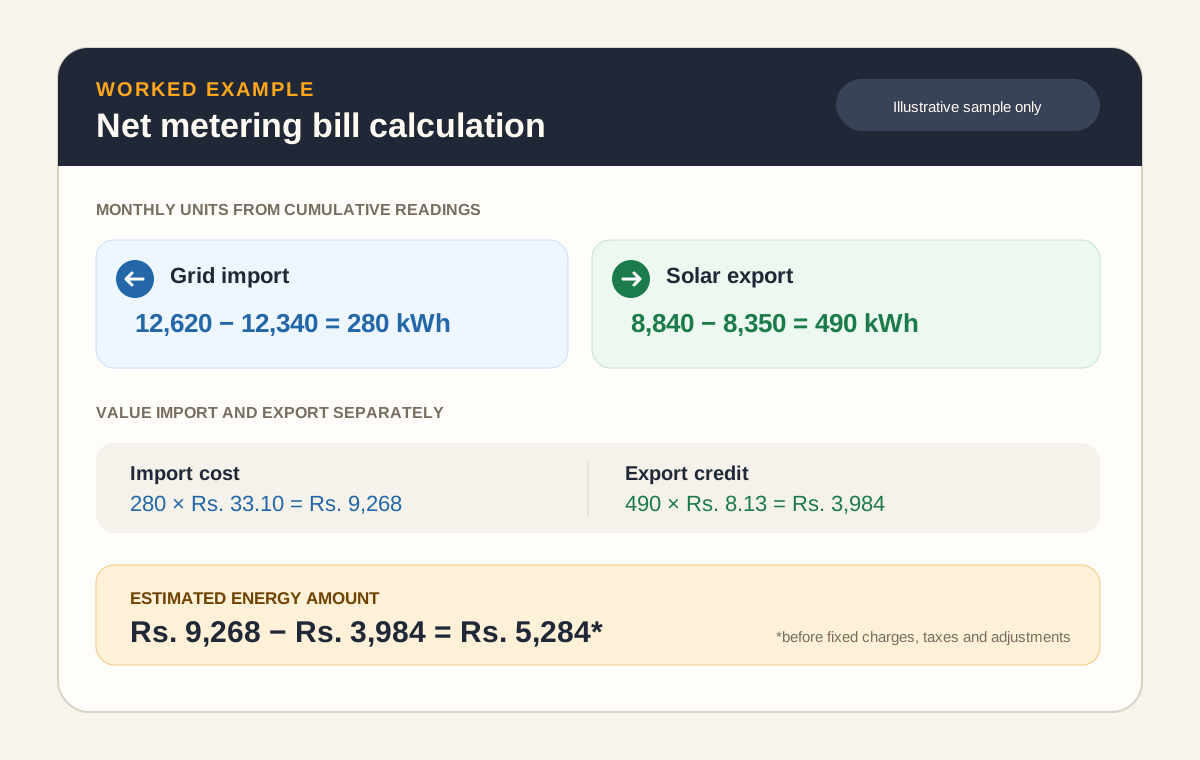
This example uses the official 2026 A-1 non-protected 201-300 unit rate and CY 2026 NAEPP, with fixed charges and bill-specific adjustments left out so the energy calculation remains clear.
Import units12,620 − 12,340 = 280 kWh
Export units8,840 − 8,350 = 490 kWh
Import cost280 × Rs. 33.10 = Rs. 9,268
Export credit490 × Rs. 8.13 = Rs. 3,984
Estimated energy amountRs. 5,284 before fixed charges and adjustments
Why can a bill still be payable after exporting more units?
The example exports 210 kWh more than it imports, but imported units cost Rs. 33.10 each while exported units receive Rs. 8.13 each. Unit balance and rupee balance are therefore not the same under 2026 net billing.
Read the display correctly
The register, the reading, and the monthly units are three different things.
A register code identifies what is being measured. The number beside it is a lifetime cumulative reading. Your monthly units are the change between two dates.
Current reading12,620
−Previous reading12,340
=Monthly import280 kWh
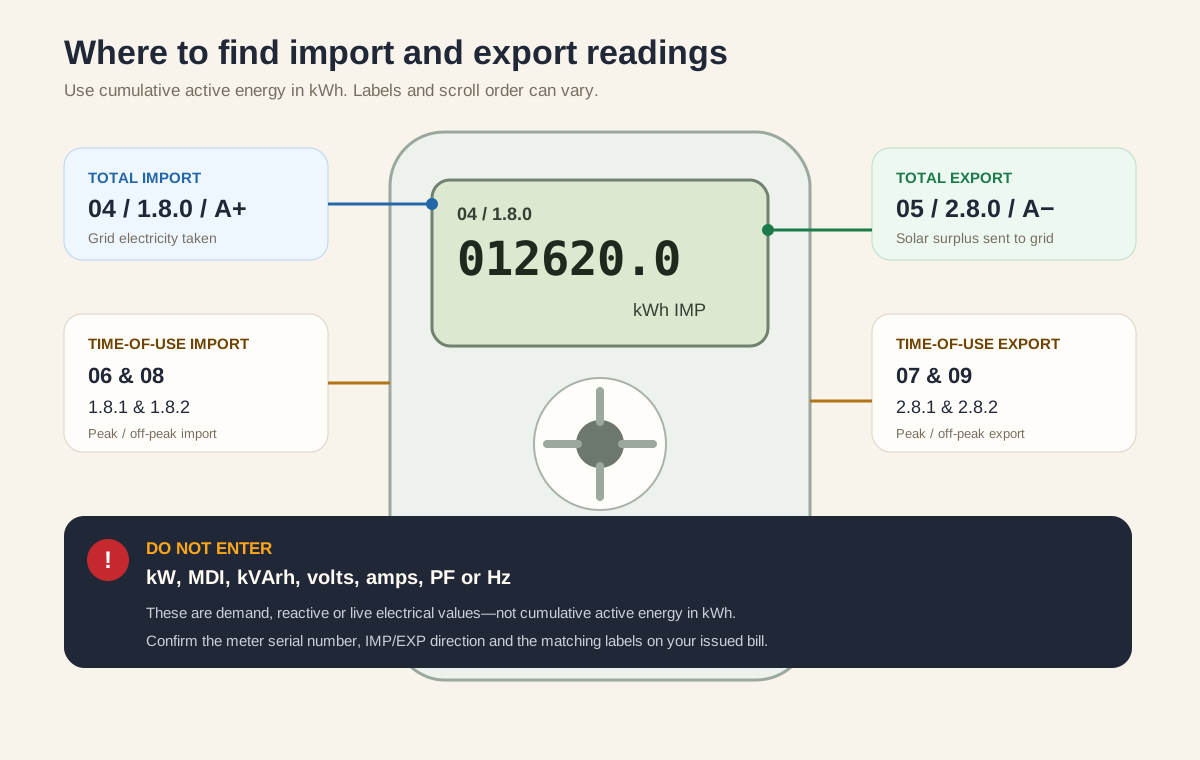
04 / 1.8.0 / A+Total active importCumulative grid electricity taken by the property.
Use in tool05 / 2.8.0 / A-Total active exportCumulative surplus solar electricity sent to the grid.
Use in tool06 & 08 / 1.8.1 & 1.8.2Peak and off-peak importTOU import buckets; confirm which tariff is T1 and T2 on your bill.
Use in tool07 & 09 / 2.8.1 & 2.8.2Peak and off-peak exportTOU export buckets; configuration can vary by meter program.
Use in toolkW / MDI / 1.6.0Maximum demandA demand reading, not cumulative monthly energy.
Do not enterkVArh / 3.8.0 / 4.8.0Reactive energyA reactive register used for power-quality or tariff purposes.
Do not enterV / A / PF / HzVoltage, current, power factor, frequencyInstantaneous electrical values, not billable kWh totals.
Do not enterImportant: export is not total solar production.
Your inverter's production includes solar used immediately inside the property. The meter's export register counts only surplus that crossed the connection point into the grid. Self-consumed solar never appears as export.
Nationwide coverage
All Pakistan DISCOs and K-Electric
The same import-minus-previous and export-minus-previous method applies everywhere. What changes is the provider, tariff category, bill format, agreement, and meter configuration.
Islamabad Electric Supply Company
Islamabad, Rawalpindi and the northern Punjab service regionFaisalabad Electric Supply Company
Faisalabad, Sargodha and adjoining central Punjab districtsGujranwala Electric Power Company
Gujranwala division and adjoining upper Punjab districtsMultan Electric Power Company
Multan and the wider southern Punjab service regionPeshawar Electric Supply Company
Peshawar and Khyber Pakhtunkhwa outside the HAZECO and TESCO territoriesHazara Electric Supply Company
The eight districts of the Hazara regionTribal Electric Supply Company
The merged tribal districts of Khyber PakhtunkhwaHyderabad Electric Supply Company
Hyderabad and lower Sindh outside the SEPCO and K-Electric territoriesSukkur Electric Power Company
Sukkur and upper Sindh service districtsQuetta Electric Supply Company
Quetta and most of Balochistan outside K-Electric's licensed territoryK-Electric Limited
Karachi and adjoining licensed areas in Sindh and BalochistanMeter companies
Supported meter manufacturers and labels
These Pakistan meter manufacturers appear on a January 2026 DISCO private-purchase reference. Approval is not permanent or universal: always obtain a fresh written NOC or use the meter supplied by your own DISCO.
Pak Elektron Limited (PEL)Use the register label or OBIS code, not the brand alone.
MicroTech IndustriesUse the register label or OBIS code, not the brand alone.
Creative ElectronicsUse the register label or OBIS code, not the brand alone.
Accurate (Pvt.) Ltd.Use the register label or OBIS code, not the brand alone.
KBK Electronics / HexingUse the register label or OBIS code, not the brand alone.
Transfopower IndustriesUse the register label or OBIS code, not the brand alone.
Intelligent Metering SystemUse the register label or OBIS code, not the brand alone.
Vertex ElectronicsUse the register label or OBIS code, not the brand alone.
AM AssociatesUse the register label or OBIS code, not the brand alone.
A manufacturer can supply several models and firmware profiles. If your maker is not listed, choose “Other / label not clear”; the calculator still works with any meter that reports cumulative active import and active export in kWh.
Rules reviewed 8 September 2026
Why the same meter readings can produce two very different bills
Net billing values imports and exports separately.
Regulation 14 of the NEPRA Prosumer Regulations 2026 bills imported kWh at the applicable tariff and credits exported kWh at the national average energy purchase price. The official CY 2026 NAEPP decision states Rs. 8.13/kWh.
A valid earlier agreement can retain its old mechanism until expiry.
S.R.O. 547(I)/2026 protects qualifying approvals and agreements executed before 9 February 2026. A material output change can affect that protection, so confirm capacity or inverter changes with the DISCO before modifying the system. Under the earlier Regulation 14 mechanism, peak units net against peak and off-peak against off-peak; surplus kWh are carried to the next cycle or paid quarterly at NAPPP.
The calculator estimates energy, not the final legal bill.
Taxes, fixed charges, duties, FCAs, QTAs, arrears, minimum charges, prior credits, maximum-demand charges and category-specific rules require the issued bill and agreement. Enter known non-energy charges above, then reconcile line by line.
Bill audit checklist
Save evidence before raising a wrong-reading complaint.
Use one dated set of records so the meter, bill, agreement and inverter data can be compared for the same period.
- 1
Photograph the meter number, date/time screen and each import/export register clearly.
- 2
Match the meter serial number and previous readings with the latest issued bill.
- 3
Confirm whether the bill labels peak/off-peak, import/export, and any carried units separately.
- 4
Keep the signed agreement, concurrence/licence, approved capacity, MCO and commissioning record.
- 5
Compare inverter production only as a reasonableness check; production is not the same as export.
- 6
If values differ, lodge the complaint with dated photos and reference number; keep the complaint ID.
Questions answered
Net metering bill calculator FAQ
How do I calculate a net metering bill in Pakistan?
Subtract each previous meter reading from its current reading to find monthly import and export separately. Under 2026 net billing, value imported units at the applicable tariff and exported units at NAEPP, then add bill-specific charges and adjustments. A protected older agreement instead nets import and export units first; any monthly surplus is carried forward or settled quarterly under the earlier mechanism.
Which meter reading is import and which is export?
Import is grid electricity taken by your property; export is surplus sent to the grid. Common identifiers are 04 or 1.8.0 for import and 05 or 2.8.0 for export. Always confirm the IMP/EXP, A+/A- or direction label because scroll order can be configured.
Do I subtract export from import?
Subtract previous from current for import and export separately first. Import minus export gives a useful physical net-unit balance. For new 2026 net billing, however, the money calculation keeps imported and exported kWh separate because they have different rates.
Why is my inverter production higher than meter export?
The inverter reports total solar generation. Your home or business consumes some of that energy immediately, and only the unused surplus reaches the export register. The difference can also include inverter data timing and measurement losses.
Can I calculate my exact electricity bill from the meter?
You can calculate monthly import/export units and estimate the energy balance. The exact bill also needs your consumer category, current tariff, taxes, fixed and demand charges, adjustments, arrears, prior export credit and agreement treatment.
What if the current reading is lower than the previous reading?
Recheck the register and meter serial number. A lower current reading can indicate that you copied a different register, the meter was replaced/reset, the billing photo is wrong, or the displayed decimal was read incorrectly. Do not calculate a negative month without verifying the MCO or reset record.
Does this work for AMI and white smart meters?
Yes. Choose the OBIS/AMI profile when the display uses 1.8.x and 2.8.x codes. The calculation only needs cumulative active import and export kWh; remote communication does not change the subtraction method.
Authorship and methodology
How this net metering bill calculator is prepared and checked
This page uses organizational authorship. It does not claim an individual electrical-engineer endorsement that has not been independently verified.
Read the authorship and methodology policy →- 1
Subtract previous from current readings separately for each import, export, peak and off-peak register.
- 2
Apply the selected 2026 net-billing or protected legacy settlement method without mixing physical units and rupee values.
- 3
Apply the official 2026 A-1 residential band automatically, including the protected consumer's one previous slab, or let another consumer category use rates copied from the issued bill. Accept fixed charges, GST, signed FCA/QTA adjustments, duty, meter rent, arrears and carried credit as rupee inputs.
- 4
Check deterministic examples and edge cases, including equal readings, export surplus, TOU registers and a carried credit greater than the amount due.
- 5
Recheck the rules and reference rate against the dated official sources linked below; the issued bill and signed agreement remain controlling.
Sources and references
Official rules and supporting references used for this calculator
NEPRA and government sources control if any summary conflicts with a notification, tariff decision, agreement or bill. The meter-maker item is a supporting third-party copy and must be rechecked with the relevant DISCO.
NEPRAProsumer Regulations 2026Metering and Regulation 14 net billingNEPRAS.R.O. 547(I)/2026 amendmentProtection for qualifying earlier agreementsNEPRANet Metering Regulations 2015Legacy carry-forward and quarterly settlement mechanismNEPRAS.R.O. 1135(I)/2018 amendmentLegacy TOU netting and NAPPP settlement mechanismNEPRAS.R.O. 1330(I)/2026 amendmentLatest approval-route amendment checkedNEPRA / GoPS.R.O. 279(I)/2026 tariff scheduleCurrent A-1 residential variable and fixed-charge ratesNEPRACY 2026 power purchase priceRs. 8.13/kWh NAEPP referencePower DivisionNet metering consumer FAQPractical meter and billing guidancePPIBNet-metering reference guideBidirectional metering and legacy processSupporting copyJanuary 2026 meter-maker NOCThird-party copy; recheck current approval with the DISCO