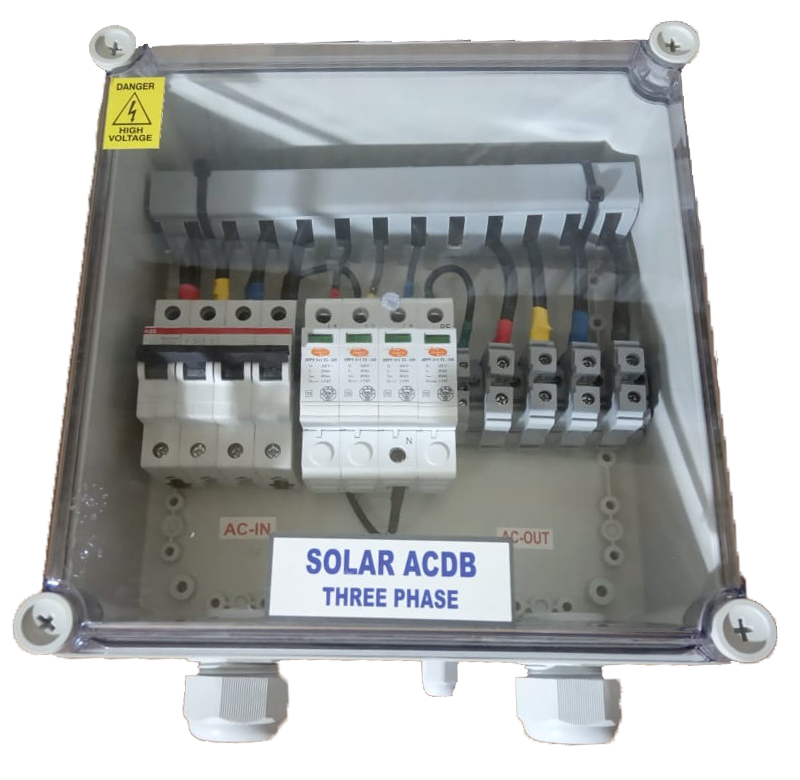
What it does—and where it belongs
The AC board protects and isolates the inverter/grid connection and, in hybrid systems, may also separate essential loads. Device ratings and RCD type depend on inverter design, fault current and the installation earthing system.
Between the inverter AC terminals and the main/essential-load distribution boards, at locations defined by the single-line diagram and utility interconnection design.
What to check before you buy
Inverter-compatible RCD
Follow the inverter manufacturer's residual-current device requirement. Type AC, A, F or B are not interchangeable labels.
Fault rating
Breaker short-circuit capacity must be at least the prospective fault current at the installation point.
Selective layout
Grid-tied output, backup output and ordinary house circuits should be unambiguous and safely segregated.
Complete assembly
Check enclosure, busbars, conductor sizing, temperature rise, neutral bars and device compatibility as one distribution-board design.
Red flags in a quotation or site visit
- RCD type selected without the inverter manual
- Backup and grid outputs share an uncontrolled neutral
- Breaker interrupting rating is omitted
- Handwritten labels do not distinguish sources
Commissioning checks to request
Ask the installer to verify
- Main, inverter and backup circuits have durable source labels
- RCD tests and trip results are recorded
- Protective conductor continuity and insulation tests are documented
- All terminals are torqued and neutral links match the approved design
Common mistakes
- —Selecting a breaker only from inverter kW
- —Treating an RCD as overcurrent protection
- —Combining essential and non-essential loads
- —Installing a generic RCD type that nuisance-trips or fails to address inverter residual current
A better quotation line item
AC protection assembly for ___ phase ___ V, inverter output ___ A, MCB/MCCB ___ A with ___ kA breaking capacity, RCD type ___ per inverter instructions, isolation and labelling, assembly designed to IEC 61439-2.
This wording is a procurement prompt, not a final engineering specification. Values must come from the approved single-line diagram and equipment manuals.
Standards and sources checked
Requirements for power switchgear and controlgear assemblies, including PV-related annexes.
General rules for RCCBs intended principally for protection against shock hazard.
Selection and application requirements for equipment in PV electrical installations.
Documentation, inspection and commissioning-test framework for grid-connected PV systems.
Pakistan project note: ask the installer to confirm the current PSQCA-adopted standard, inverter instructions, earthing rules and the latest DISCO/NEPRA interconnection requirements applicable to your site.
Questions about AC DB
Which RCD type should a solar inverter use?
Use the exact inverter manufacturer's instruction together with the installation design. Transformerless inverters can have residual-current characteristics that make a generic answer unsafe.
Can the inverter feed an existing spare breaker?
Only after confirming busbar rating, connection position, cable protection, isolation, labelling, fault level and the approved interconnection design.