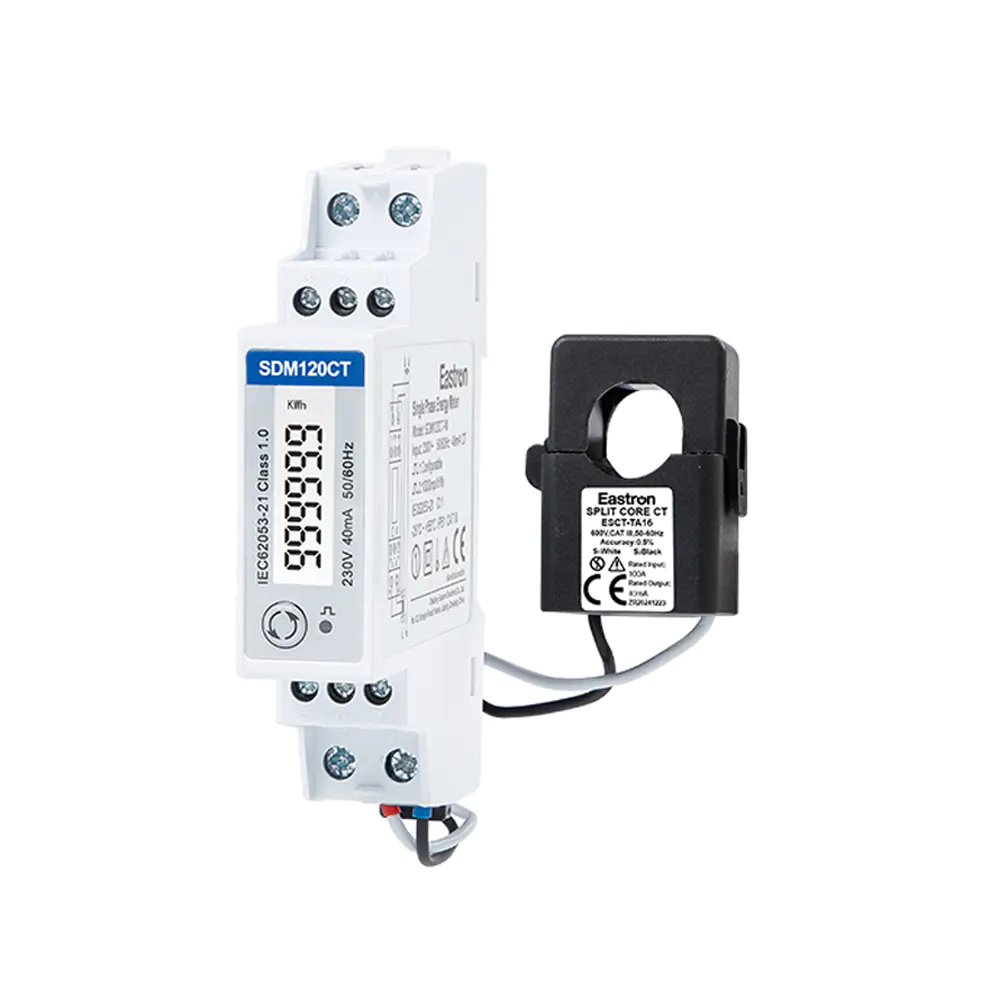
What it does—and where it belongs
A smart meter or current transformer supplies directional power data to the inverter/energy-management system. It is different from the utility's billing meter, even if both measure import and export.
At the grid connection or monitored feeder, with voltage reference and communication wiring to the inverter or data logger. CT direction and phase mapping are critical.
What to check before you buy
Approved compatibility
Use a meter/CT named by the inverter manufacturer, with the required communication protocol and firmware support.
Correct measurement point
Export control works only if the sensor sees the complete site exchange, not merely the inverter output.
CT rating and orientation
Primary rating, conductor window, arrow direction, phase order and secondary safety all need a documented plan.
Billing boundary
The customer monitoring meter does not replace the bidirectional utility meter or DISCO approval process.
Red flags in a quotation or site visit
- A generic Modbus meter is assumed compatible
- CT arrow and phase labels are ignored
- Zero-export claim is not verified with a real load/export test
- Monitoring meter is advertised as the utility billing meter
Commissioning checks to request
Ask the installer to verify
- Import and export directions display correctly
- Each CT matches its voltage phase
- Communication cable route and termination follow maker guidance
- Export-limit response is tested across changing loads
Common mistakes
- —Clamping the CT around both phase and neutral
- —Installing sensor downstream of loads that should be measured
- —Wrong CT ratio
- —Reversing one phase in a three-phase system
A better quotation line item
Inverter-approved bidirectional energy meter/CT set for ___ phase, service current ___ A, CT ratio ___/___ A if applicable, communication ___, installed at the point of common coupling and commissioned for correct phase/direction mapping.
This wording is a procurement prompt, not a final engineering specification. Values must come from the approved single-line diagram and equipment manuals.
Standards and sources checked
Accuracy requirements for static AC active-energy meters.
Pakistan context for bidirectional metering and utility-approved interconnection protection; confirm the final applicable rules with the local DISCO.
Documentation, inspection and commissioning-test framework for grid-connected PV systems.
Pakistan project note: ask the installer to confirm the current PSQCA-adopted standard, inverter instructions, earthing rules and the latest DISCO/NEPRA interconnection requirements applicable to your site.
Questions about Smart meter / CT
Is the inverter smart meter the same as the DISCO meter?
Usually not. The inverter meter supports monitoring or export control; the utility installs or approves its own revenue-grade bidirectional meter.
Why does the app show negative house load?
The common causes are a reversed CT, wrong phase mapping, an incorrect CT ratio or a sensor installed at the wrong point.