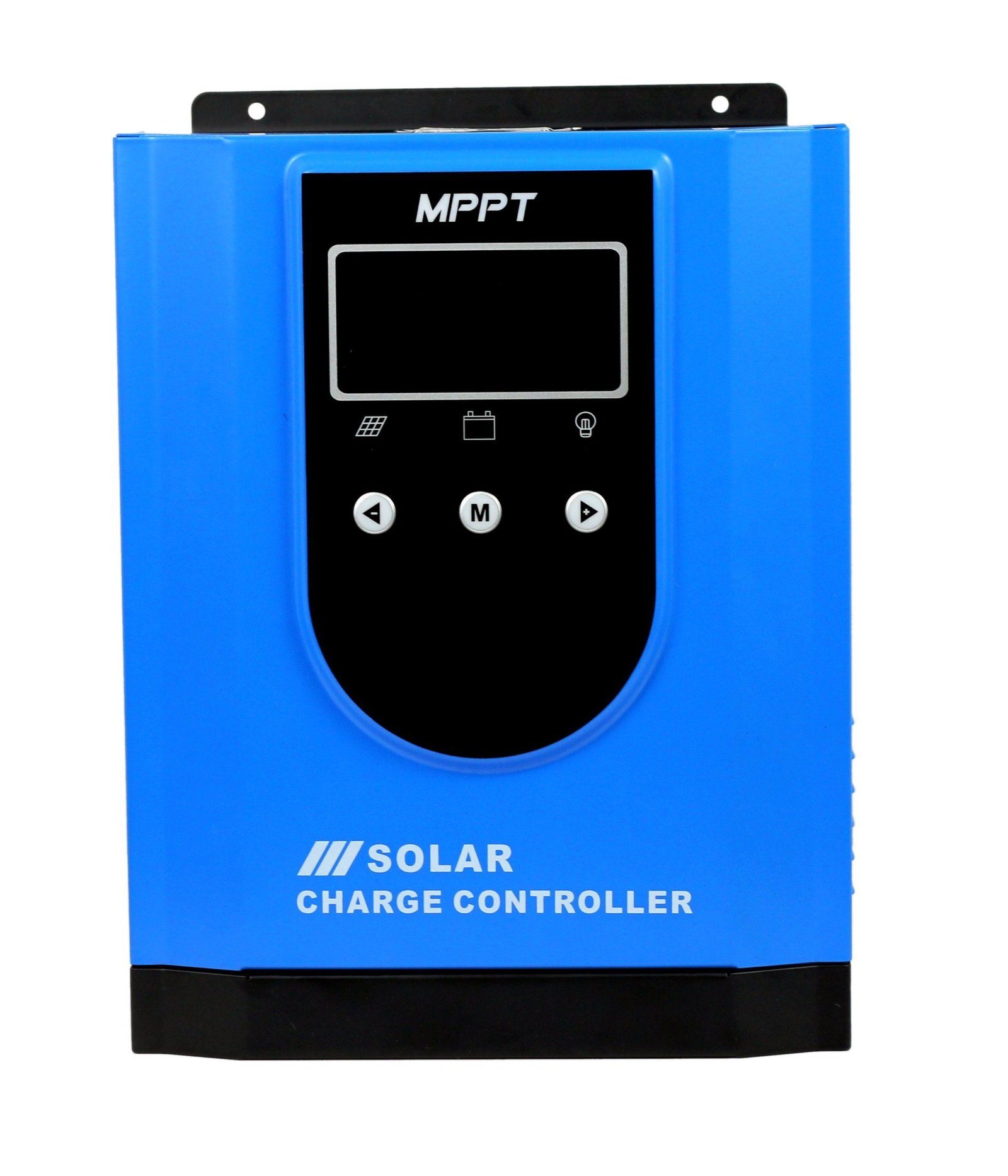
What it does—and where it belongs
An MPPT controller tracks the array operating point and regulates battery charge. It is needed when PV charges a battery outside an inverter's built-in charger; most modern hybrid inverters already include MPPT inputs.
Between the PV array and battery bank, with short, correctly protected battery conductors and a PV input kept within all controller limits.
What to check before you buy
Three separate limits
Check maximum PV voltage, maximum PV short-circuit/input current and maximum battery charge current. A single watt rating hides these constraints.
Battery compatibility
Lithium systems need an approved charge profile and often BMS communication; lead-acid systems need correct absorption, float and temperature compensation.
Thermal output
Charge current can derate in high ambient temperature. Review ventilation, enclosure rating and the maker's temperature curve.
Protection and isolation
PV input and battery output need separately designed disconnects and overcurrent protection; battery fault current can be very high.
Red flags in a quotation or site visit
- Panel watts are below the headline rating but string Voc exceeds controller maximum
- A 12 V-only controller is used on a 24/48 V bank
- Lithium charging is configured without battery-maker approval
- Battery cables have no close, correctly rated overcurrent protection
Commissioning checks to request
Ask the installer to verify
- Battery is connected/configured in the sequence required by the maker
- Cold-weather PV Voc and array Isc calculations are documented
- Battery/BMS current and voltage limits match settings
- Controller has ventilation and logged operating temperatures stay within rating
Common mistakes
- —Sizing from nominal panel voltage
- —Confusing PV input current with battery output current
- —Ignoring lithium BMS communications
- —Paralleling controllers without coordinated charge settings
A better quotation line item
MPPT charge controller for ___ V battery, charge current ___ A, PV absolute maximum ___ V, PV Isc limit ___ A, supported PV power ___ W at battery voltage, chemistry/profile ___, BMS communication ___, protection and temperature sensor as required.
This wording is a procurement prompt, not a final engineering specification. Values must come from the approved single-line diagram and equipment manuals.
Standards and sources checked
Minimum performance and functional requirements for PV battery charge controllers used with lead-acid batteries.
A manufacturer example showing why PV open-circuit voltage, input current and battery charge current are separate controller limits.
PV array design requirements covering DC wiring, protection, switching and earthing.
Pakistan project note: ask the installer to confirm the current PSQCA-adopted standard, inverter instructions, earthing rules and the latest DISCO/NEPRA interconnection requirements applicable to your site.
Questions about MPPT controller
Do I need an MPPT controller with a hybrid inverter?
Usually not if the panels connect to the hybrid inverter's built-in MPPT inputs. A separate controller is for a separate DC-coupled battery path or specialised architecture.
Can I exceed the controller's PV watt rating?
Some manufacturers allow limited array oversizing, but the absolute PV voltage and input short-circuit-current limits must never be exceeded. Follow that exact model's manual.