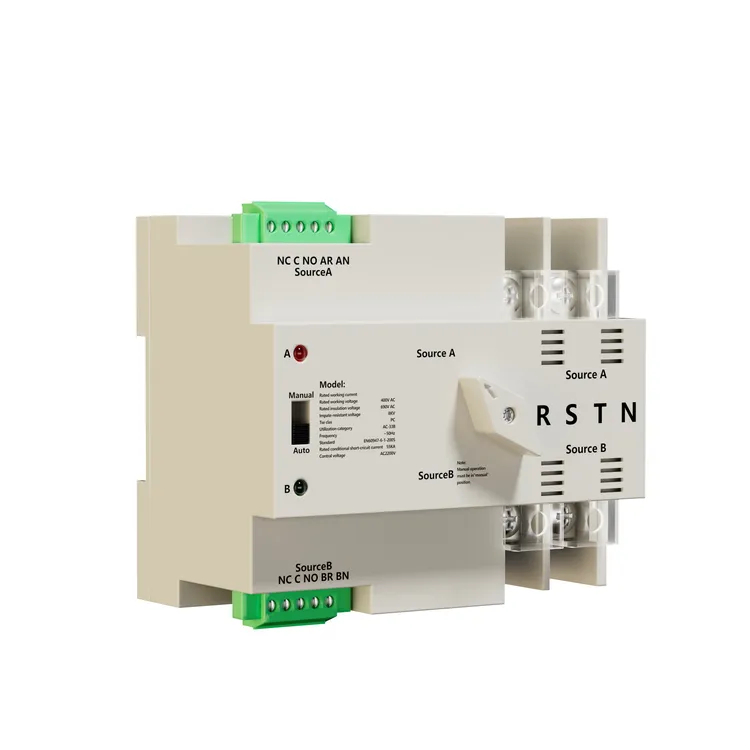
What it does—and where it belongs
An ATS is source-transfer equipment. It manages continuity and separation between supplies; it does not create backup power and must not be used to bypass inverter anti-islanding or utility interconnection rules.
On the AC side, commonly ahead of an essential-load distribution board. Some hybrid inverters include a certified internal transfer function, while larger systems use external transfer equipment.
What to check before you buy
Complete type-tested equipment
Prefer a manufacturer-declared transfer switch assembly rather than two contactors and a generic timer assembled without verified interlocking.
Neutral strategy
Three-pole versus four-pole transfer is an earthing and source-design decision. It cannot be chosen from phase count alone.
Utilisation category
Motor loads, pumps and compressors can demand different making/breaking capability from resistive loads.
Fail-safe controls
Check mechanical and electrical interlocking, source sensing, time delays, manual operation and a defined safe state on controller failure.
Red flags in a quotation or site visit
- Two contactors without mechanical interlock
- No declared transfer-switch standard
- Neutral treatment is unspecified
- ATS rating is based only on inverter kW and ignores load current or motor starting
Commissioning checks to request
Ask the installer to verify
- Utility and backup sources cannot be paralleled unintentionally
- Essential and non-essential loads are clearly separated
- Manual bypass or operation procedure is labelled
- Functional transfer tests include loss and restoration of each source
Common mistakes
- —Using an ATS to backfeed the grid
- —Switching only phase conductors without reviewing neutral and earthing
- —Putting the whole property on a small backup output
- —Ignoring generator warm-up/cool-down or inverter transfer limits
A better quotation line item
Automatic transfer switching equipment for Source A ___ and Source B ___, ___ phase, ___ poles, ___ A, open-transition unless otherwise designed, utilisation category ___, mechanically and electrically interlocked, IEC 60947-6-1 evidence.
This wording is a procurement prompt, not a final engineering specification. Values must come from the approved single-line diagram and equipment manuals.
Standards and sources checked
Current standard for manual, remote and automatic transfer switching equipment.
Requirements for power switchgear and controlgear assemblies, including PV-related annexes.
Pakistan context for bidirectional metering and utility-approved interconnection protection; confirm the final applicable rules with the local DISCO.
Pakistan project note: ask the installer to confirm the current PSQCA-adopted standard, inverter instructions, earthing rules and the latest DISCO/NEPRA interconnection requirements applicable to your site.
Questions about ATS
Do I need an ATS with a hybrid inverter?
Not always. Many hybrid inverters have an internal transfer function for their backup output. An external ATS is needed only when the approved system architecture calls for it.
Should the ATS switch neutral?
That depends on whether each source is a separately derived supply and on the earthing arrangement. It must be decided by the electrical designer, not assumed from a generic diagram.