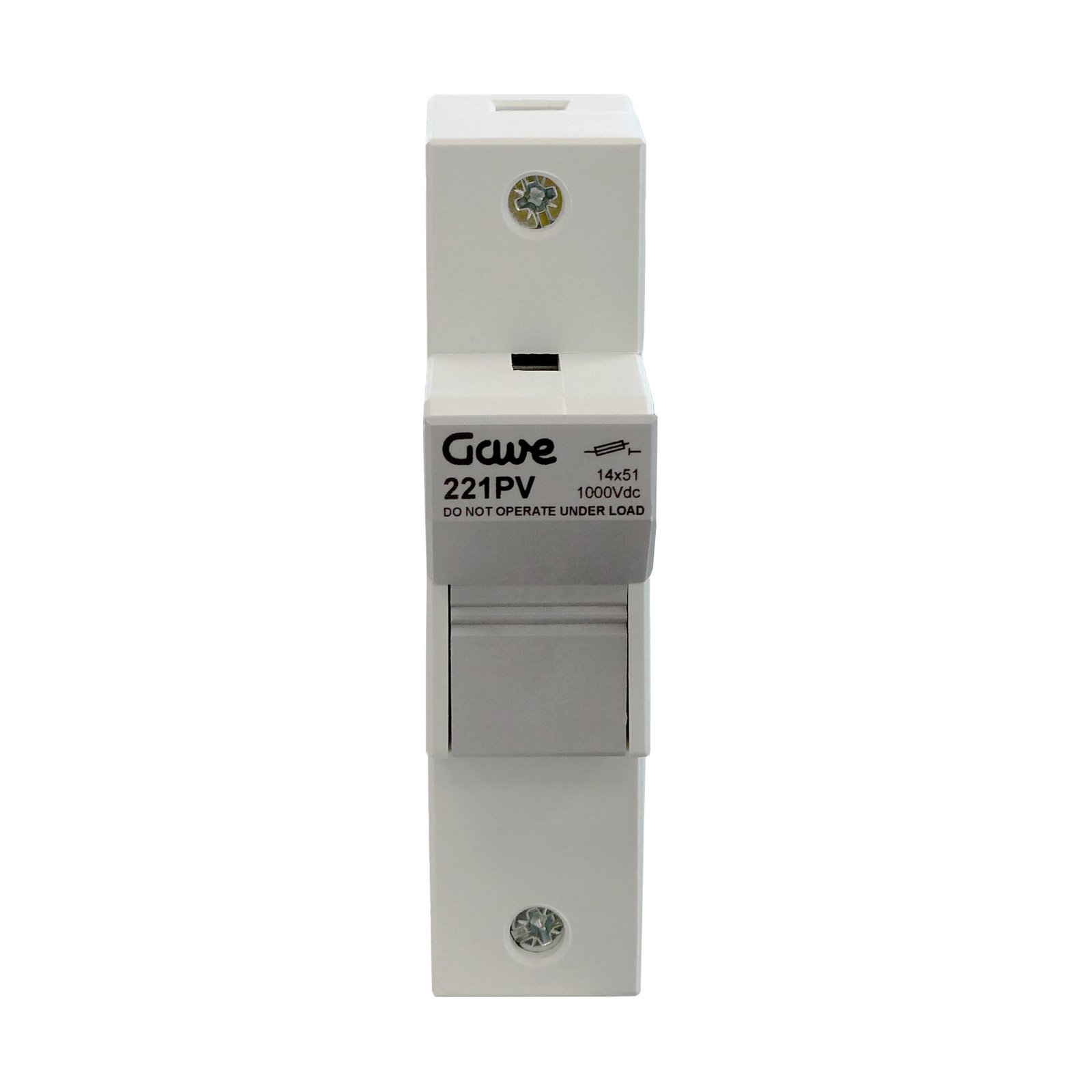
What it does—and where it belongs
A gPV fuse is built for the unusual low fault-current and high-voltage characteristics of PV arrays. Whether a string needs fusing is calculated from parallel-source current and module/cable limits; it is not determined by system size alone.
Usually in a string combiner, inline fuse assembly or inverter-integrated fuse section, on one or both live conductors as required by the earthing arrangement.
What to check before you buy
gPV marking
General-purpose cylindrical fuses can behave differently at low PV fault currents. Use fuse-links specifically evaluated for PV protection.
Holder as a system
Holder voltage, current, touch protection, temperature derating and fuse size must all match the selected link.
Module coordination
The fuse rating cannot exceed the module manufacturer's maximum series-fuse rating and must protect the cable.
Accessible replacement
Provide safe isolation, labels and a procedure; a fuse holder is not automatically a load-break switch.
Red flags in a quotation or site visit
- Ordinary AC fuse-link in a PV holder
- Fuse amp rating equals module maximum-series-fuse rating without a design calculation
- Fuse holder is opened under load
- Different fuse brands/types are mixed without holder compatibility data
Commissioning checks to request
Ask the installer to verify
- Fuse locations and ratings match the string schedule
- Spare fuses are the exact approved type and rating
- Holder temperature and conductor terminations are within maker limits
- Commissioning includes polarity and string-current checks before closing
Common mistakes
- —Installing fuses in every small array without checking whether they are required
- —Assuming a fuse provides routine isolation
- —Ignoring reverse current from all other parallel strings
- —Sizing from Imp alone
A better quotation line item
PV string fuse-link class gPV, ___ A, minimum ___ V DC, breaking capacity ___ kA, size ___, coordinated with module maximum series-fuse rating and cable; matching touch-safe PV fuse holder compliant with IEC 60269-6.
This wording is a procurement prompt, not a final engineering specification. Values must come from the approved single-line diagram and equipment manuals.
Standards and sources checked
Supplementary requirements for fuse-links protecting PV strings and arrays up to 1,500 V DC.
Manufacturer application guidance for PV string and output-circuit protection.
PV array design requirements covering DC wiring, protection, switching and earthing.
Pakistan project note: ask the installer to confirm the current PSQCA-adopted standard, inverter instructions, earthing rules and the latest DISCO/NEPRA interconnection requirements applicable to your site.
Questions about PV fuses
Does every solar string need a fuse?
No. Fusing is generally required when parallel strings or other sources can drive damaging reverse current. The array designer checks module, cable and source limits.
Can I pull a fuse holder to switch off the string?
Not unless the holder is explicitly rated for load switching, which many are not. Use the specified isolating procedure and device.