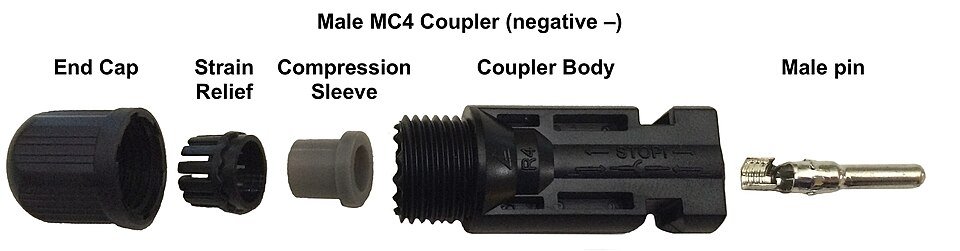
What it does—and where it belongs
A PV connector is a matched male/female system with specific contacts, seals, cable ranges and assembly tools. Similar-looking connectors are not automatically compatible.
At module leads, extension cables, branch connectors, combiner inputs and some inverter inputs on the PV DC side.
What to check before you buy
No cross-mating
Match the connector already fitted to the module or replace the complete mated pair with an approved system. A label saying 'compatible' is not enough.
Authenticity and traceability
Buy complete connector sets with maker markings, packaging, assembly instructions and a supply chain you can trace.
Cable match
Contact barrel and sealing gland must both match conductor area and cable outside diameter.
Tooling
Correct strip length, crimp die, pull check and final tightening are part of the connector system—not optional workmanship preferences.
Red flags in a quotation or site visit
- Mixed brands on a mated pair
- Contacts are folded with pliers instead of crimped
- Loose gland or seal around a small cable
- Connector lies in standing water or directly on the roof
Commissioning checks to request
Ask the installer to verify
- Every field-made connector passes the documented pull/visual check
- No connector is mated or unmated under load
- Caps protect unmated connectors from dust and moisture
- Connector family is recorded in the as-built documentation
Common mistakes
- —Calling every locking PV plug 'MC4'
- —Reusing contacts or connector bodies
- —Crimping with a general-purpose tool
- —Assuming a click alone proves correct contact engagement
A better quotation line item
PV connector pair from one manufacturer and product family, ___ V DC, ___ A for ___ mm² cable with ___–___ mm outer diameter, IEC 62852 evidence, supplied with matching contacts, seals and maker-approved assembly instructions.
This wording is a procurement prompt, not a final engineering specification. Values must come from the approved single-line diagram and equipment manuals.
Standards and sources checked
Safety requirements and tests for PV DC connectors up to 1,500 V DC.
Manufacturer guidance explaining why connector halves from different makers should not be cross-mated.
PV array design requirements covering DC wiring, protection, switching and earthing.
Pakistan project note: ask the installer to confirm the current PSQCA-adopted standard, inverter instructions, earthing rules and the latest DISCO/NEPRA interconnection requirements applicable to your site.
Questions about PV connectors
Are all 'MC4-compatible' connectors safe to mate together?
No. IEC installation guidance and major connector manufacturers require mated halves to be the same type and from the same manufacturer. Similar geometry does not prove long-term electrical or sealing compatibility.
Can a connector be unplugged in daylight?
Never disconnect a PV connector under load. The circuit must be isolated using the approved shutdown procedure and verified by a qualified person.